




Capsulab is Coboi lab’s monthly knowledge capsule. We want to share our internal research on topics such as innovation, labs and multi-actor projects, among others. And, from there, generate concise and practical content and materials with the aim of sharing the key learnings.
In this capsule we talk about:
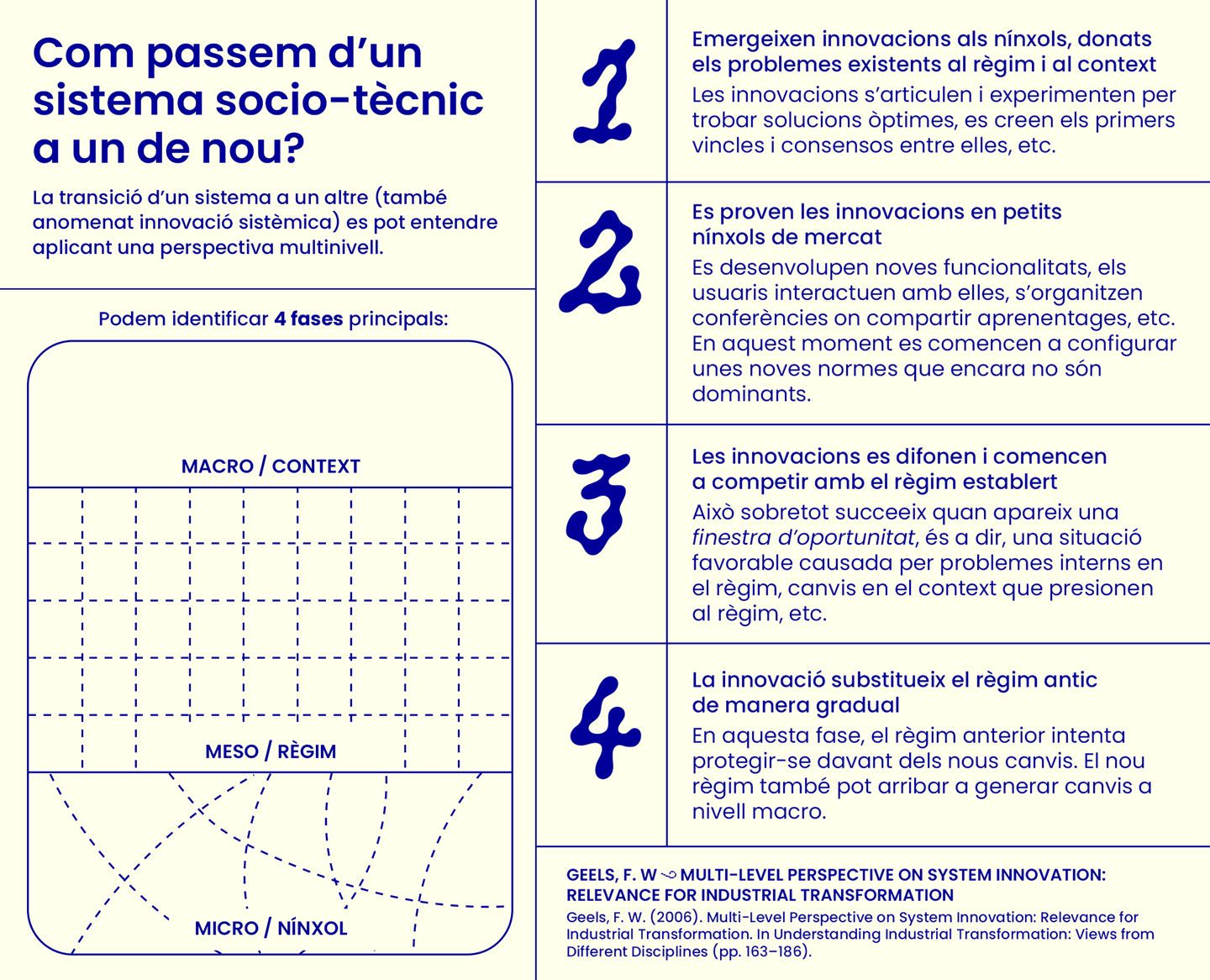
The transition from one system to another (also referred to as systemic innovation) can be understood through a multilevel perspective. This approach distinguishes three different levels to understand systemic innovations:
- Meso – Regime. This refers to the set of rules that guide and coordinate the activities of key actors within the current system and, as a result, produce dynamic stability.
- Micro – Niches. These are protected space where innovations emerge, experiment, learn and connect with each other. Within niches it is possible to deviate from the regime’s rules.
- Macro – Context. This level includes broader environmental factors that influence the system, such as globalization, climate change, or cultural shifts. Regime actors cannot exert direct influence on the context.
We can identify 4 main phases:
- Innovations emerge within niches, triggered by existing problems in the regime and the broader context. These innovations are developed, tested and refined to find effective solutions, the first links and consensuses are created between them, etc.
- Innovations are tested in small market niches. New functionalities are developed, users interact with them, conferences are organized to share learnings, etc. At this stage, new norms are beginning to be configured although they are not yet dominant.
- Innovations start to spread and compete with the established regime. This especially happens when a “window of opportunity” arsises -such as internal problemes within the regime or external pressures from contextual changes- creating favorable conditions for disruption.
- Innovation gradually replaces the old regime. In this phase, the previous regime tries to protect itself from new changes. The new regime may also generate changes at the macro level.
In conclusion, the multilevel perspective suggests that systemic innovations occur when changes at different levels reinforce one another. This implies that system transitions are the result of interactions among multiple processes and actors over time.
Source: Geels, FW (2006). Multi-Level Perspective on System Innovation: Relevance for Industrial Transformation. In Understanding Industrial Transformation: Views from Different Disciplines (pp. 163–186). ( link here )
If you want to receive the latest news from capsulab , you can subscribe through this form .
With the support of: