



Capsulab is Coboi lab’s monthly knowledge capsule. We want to share our internal research on topics such as innovation, labs and multi-actor projects, among others. And, from there, generate concise and practical content and materials with the aim of sharing the key learnings.
In this capsule we talk about:
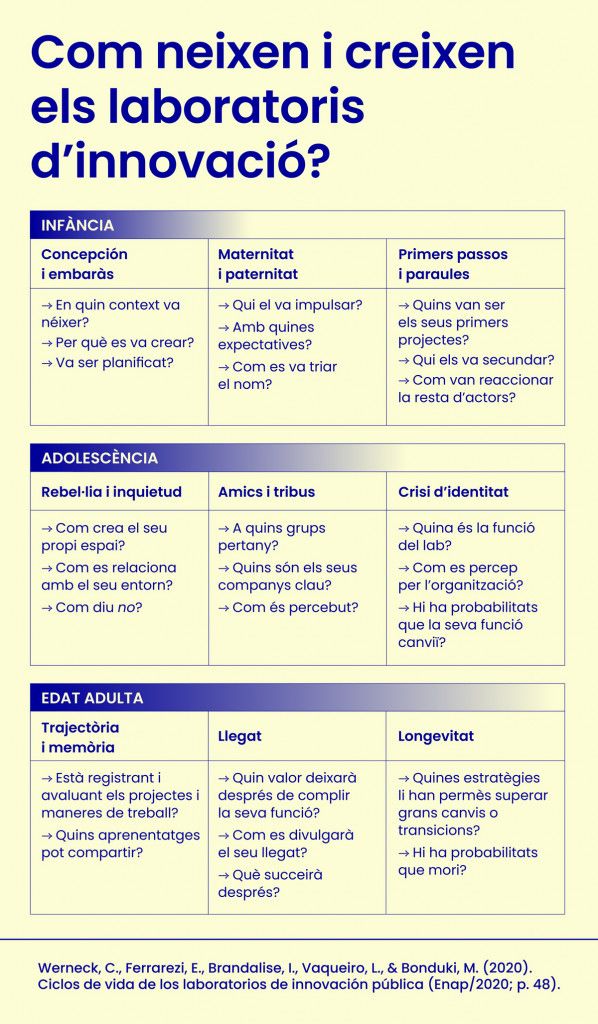
In this report from (011).lab , the innovation laboratory of the São Paulo government, a parallel is drawn between the life cycles of people and those of innovation labs. The life of the lab, just like a person’s, is divided into three main stages:
- Childhood . What is a lab in its infancy like?
- Conception and pregnancy. Was it planned? In what context was it born? Why was it created?
All labs are born in a specific context. Before they are even born, a founding team begins to prepare the space and define their core capabilities. Often, they look to other existing labs for inspiration and to shape the narrative of their own creation. The constitution of a specific physical space plays a fundamental role in the materialization of the transformations to which the laboratory aspires. The very act of conceiving a lab represents a break from the norm, since it is a new structure that is born precisely with the promise of innovation. - Maternity and paternity. Who initiated the lab? With what expectations? How was the name chosen?
Labs are usually driven by political leadership and entrepreneurial civil servants. The lab emerges as “the child of a controlling mother and a hippie father” who have a set of dreams and expectations about what surrounds the lab (often unclear or unrealistic). Labs need the specific care of these people during childhood until their basic structure is formed to have a healthy life. A key moment comes when the “umbilical cord” is cut, when the lab assumes its own identity and culture. - First steps and words. Wasthe lab formally created? What were its first projects? Who supported them? How did the rest of the actors react?
Like a newborn, a laboratory in this phase does not yet know who it is. It begins discovering and developing itself through its first projects -often bold initiatives that test boundaries. Labs must quickly learn to find their footing and understand how to align their emerging capabilities with external demands. At this stage, it’s also crucial to form a team with the right skill sets. Labs also tend to seek institutional recognition -what could be seen as a birth certificate. However, they may also be perceived internally as a threat to the organisational culture.
- Conception and pregnancy. Was it planned? In what context was it born? Why was it created?
- Adolescence. What is a laboratory like in adolescence?
It is a time of questions, discoveries, demands, dramas, turbulence, contradictions, crises and instabilities.- Rebellion and restlessness. How to conquer your own space? How to manage the relationship with your environment? How to say “no”?
This is a period full of questions, trials, challenges and contradictions. Labs in adolescence try to change their environment quickly but run into barriers. They begin to distance themselves from the privileges of childhood and acquire responsabilities expected of more mature structures. Without yet being fully recognised as adults, their behaviour can be seen as inappropriate or overly provocative. They risk alienating allies or funders who view the lab’s ecosystem as unstable. Labs feel pressured to show results, to prove themselves with small wins and fast deliverables. Meanwhile, they begin making independent decisions and developing a more distinct identity. Parents decide less and less about his life and expect a balance between leisure and obligation. “No” can also be a problem, both in accepting it and saying it. - Friends and tribes. What groups does they belong to? Who are their key peers? How are they perceived?
These are confusing years. Labs seek role models and communities to belong to, learning from their peers. They start building networks of collaborators, sometimes with people their “parents” (founders) know nothing about. Even small, discreet and cost-free project with a committed colleague can trigger a small victory that gives momentum to the lab. However, labs can also fall into stereotypes of what a successful lab should be. - Identity crisis. What is the lab’s role? How is it perceived by the host organization? Is there a possibility that its function will change?
During adolescence, labs struggle to define their brand since they are focused on developing projects while analyzing their role in the organization. In addition, they undergo physical, mental and social changes. It is the time when they ask themselves deep questions. By focusing on their identity, there may be a risk of distancing themselves from their closest environment. It is common for a lab’s self-image to differ from how others see it. Citizens often don’t understand what this “new thing” is. Labs face increasing demands to show results while navigating self-doubr and transformation. They may begin questioning early beliefs or practices.
- Rebellion and restlessness. How to conquer your own space? How to manage the relationship with your environment? How to say “no”?
- Adulthood. What is a lab like in adulthood?
Serenity in acting and recognition within the public administration are characteristic aspects of this period.- History and memory. Are you documenting and evaluating projects and ways of working? What lessons can be drawn?
In adulthood, labs have a clearer identity and a stronger sense of responsabilily. They no longer feel miunderstood or alone in their desire to change the public sector. However, it continues to reflect on its own practice. It reviews and evaluates its trajectory (learnings, priorities, etc.) and seeks to preserve memory (documenting processes, projects, ways of doing things, etc.). They take time to organize information, document processes and build internal knowledge. However, it runs the risk of living on past memories, socializing less and reducing experimentation. It is tempting to live only on memories and glories obtained in the past, narrated in a heroic way to legitimize its existence. Preserving the memory of the organization and identifying lessons learned is the first step for laboratories to carry out an evaluation. There is dedication to documenting processes, projects and ways of doing things. - Legacy. What value will it leave after his death? How will its legacy be shared? What will happen after it has fulfilled its role?
The adult lab has more recognition than in previous stages. It is beginning to be perceived as relevant and necessary. Others also tend to recognize its function.
For this reason, it seeks to build a legacy for the innovation ecosystem. Its legacy makes autonomy in projects and working methods possible. There is an increase in the state’s capacity to build new responses to complex public problems, which in turn requires a change of mentality, often systemic, to generate a paradigm shift and not fall into passing idioms. Based on its knowledge and learning, it works to stimulate the innovation capacity of its organization and generate a lasting impact on the system. However, it develops the difficulty of opening up to new habits. The tendency to sociability tends to decrease over the years. Maintaining an active network is key to avoiding loneliness and stagnation. - Longevity. What strategies have allowed the lab to overcome major changes or transitions? Is there a chance of dying?
Faced with major challenges, the adult lab reflects more deeply and can now say “no” firmly when needed. It uses lived experiences as a source of wisdom to read situations, look towards desirable futures and explore possibilities in order to discern and make decisions with serenity and move forward. One of its greatest concerns is its continuity and sustainability over time. It reflects on what actions or strategies it must carry out to continue with its function (expand its areas of work, reach a wider audience, etc.). The concern of maturity is how to preserve the experimentation of the laboratory itself. It questions whether it is on the desired path, whether it should change its lifestyle, its behavior and its priorities. Ideally, labs in this stage work in closer integration with public institutions, becoming part of the system rather than adjacent to it. If the lab fails to adapt to critical transitions, however, it is possible that the lab will die.
- History and memory. Are you documenting and evaluating projects and ways of working? What lessons can be drawn?
In conclusion, the report highlights that certain challenges persist across all life stages, such as the search for one’s own essence, the relationship with family, or transitions (both political and personal).
Source: Werneck, C., Ferrarezi, E., Brandalise, I., Vaqueiro, L., & Bonduki, M. (2020). Life cycles of public innovation laboratories (Enap/2020; p. 48).
If you want to receive the latest news from capsulab , you can subscribe through this form .
With the support of: