




Capsulab is Coboi lab’s monthly knowledge capsule. We want to share our internal research on topics such as innovation, labs and multi-actor projects, among others. And, from there, generate concise and practical content and materials with the aim of disseminating the main learnings.
In this capsule we talk about:
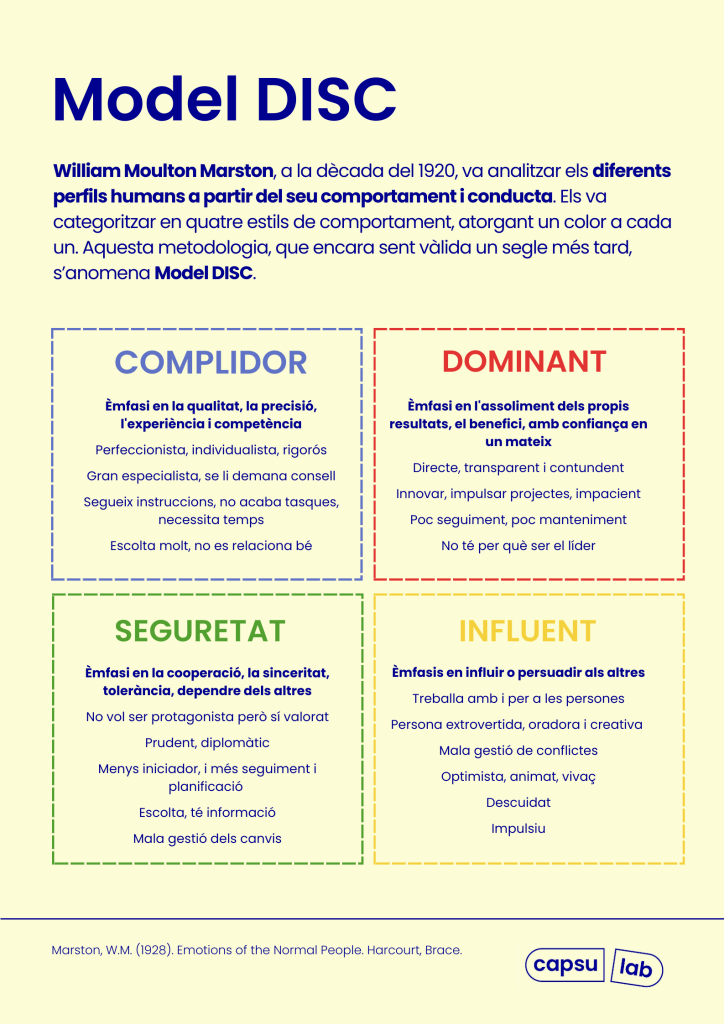
William Moulton Marston , at the beginning of the 20th century, analyzed the different human profiles based on their behavior and conduct, and categorized them into 4 behavioral styles, assigning a color to each one. This methodology, which is still valid a century later, is called the DISC Model .
This analysis does not mean to conclude that all people who are part of the same prototype are the same, since each one behaves in a particular way. However, this model can serve as a good guide to define the behavioral profile, both our own and those of the people around us, and thus understand ourselves better.
The four prototypes:
Dominant people emphasize achieving their own results with self-confidence. They enjoy being in positions of
These people are clear and concise , persistent and confident . They are innovative thinkers with a lot of initiative and are not afraid to take risks or try something new. They respond very well to logic, reason and information, but not so much to emotion. They want
Their innate fear is that they will be taken advantage of, especially by someone they trust. Because of this, they tend to strive for positions of authority, where they can be in charge of decision-making and control of environments.
Keywords: adventurous, determined, innovative, direct, promoter and competitive.
Influential people emphasize influencing or persuading others . They are characterized by their
These people thrive on fun experiences and being with other people. They have no problem talking to strangers or being the center of attention . Because of this personality trait, they can make people feel integrated and motivated. They bring a positive sense of humor and attitude. They are very creative, and have an easy time negotiating and resolving conflicts . They pay little attention to details . They can be bad with time and even in creating a strategy. They have a greater predisposition to promise than to get involved . They may tend to listen only when it is convenient, and may be perceived as “waiting for their turn to speak.” They may abuse gestures and facial expressions to communicate.
Their innate fear is of being rejected by others. As a result, they express themselves as fun, outgoing, and friendly.
Keywords: likeable, optimistic, persuasive, popular, sociable and enthusiastic.
Security people emphasize cooperation , sincerity , tolerance , and dependence on others . They have a
They are loyal and supportive team members, sincere and trustworthy. They are content with authority,
Their innate fear is losing their safety and security. As a result, they create routines and resist change.
Keywords: friendly, patient, sincere, calm, stable and with the ability to listen.
Compliant people emphasize quality , precision , experience , and competence . They tend to have a rigid physical appearance and rely on data to gather as much information as possible and form an opinion. They are not usually convinced of what they cannot verify for themselves. They keep their distance , speak only when they have something to say, and rarely gesture.
Compliers are perfectionists . They think very logically , precisely, analytically and systematically . They tend to be excellent at problem solving and creative thinking . They have a realistic perspective on the situation, and are able to point out all the reasons why something will not work. They tend to be quiet and sometimes solitary. They define the situation well, and make sure that others have the accurate information, and thus, work to achieve consensus. They can get stuck in the details , being too subject to the procedure and method. They may prefer to work alone than with a team. They can sometimes be perceived as a negative figure, for being very critical and argumentative people.
Their innate fear is of being criticized, especially for their work. As a result, they spend a lot of time and energy trying to be precise and correct.
Keywords: precise, exact, fact-finding, diplomatic and analytical.
Source: Marston, WM (1928). Emotions of the Normal People. Harcourt, Brace .
If you want to receive the latest news from capsulab , you can subscribe through this form .
With the support of: